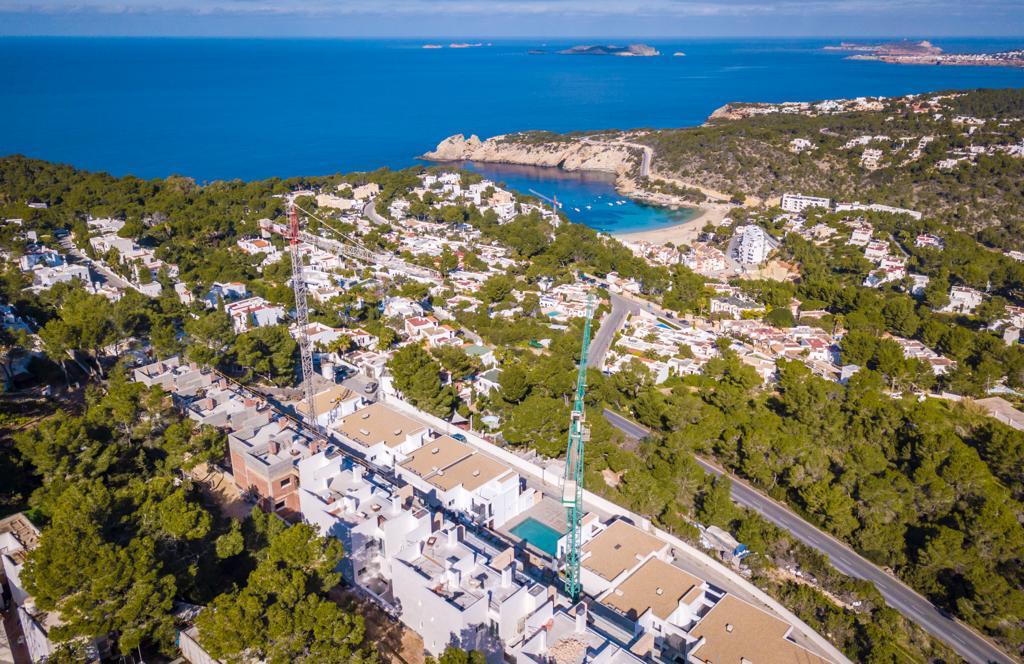


Would you like to buy a house in Ibiza? In cooperation with our partner Resa Estates We offer homes and apartments on the Spanish island of Ibiza.
If you are interested, we would be happy to put you in touch with Geraldine Lansen, the local real estate agent in Ibiza. Geraldine is originally Dutch, speaks Dutch, Spanish and English fluently, and knows everything about the local housing market.
Dutch citizens and other residents of EU countries are allowed to travel freely to Spain to live and work with a valid identity card. If you want to buy a house in Ibiza, you need a NIE number, similar to the national identity number. You need this document for tax filing, insurance, opening a bank account, registering with the municipality for stays longer than three months, and for contracts such as internet, water, and electricity.
This document is an extract from the property deed, the Registro de la Propiedad. All homeowners must register their Spanish property there. This document describes both the legal and financial and fiscal information:
In addition, you will find an exact description of the layout and the area of the property and the plot of land. We always require a recent proof of payment for, among other things, municipal taxes and property tax; these must also be presented upon passing.
Since July 2013, every home must have an energy label. The selling party is responsible for this.
If there is agreement between the seller and the buyer, the lawyer checks whether the property can actually be passed. A preliminary sales contract is drawn up and a first payment is made, often ten percent of the agreed price, to the seller or to an account of the notary. The remaining amount is transferred upon passing. Both the reservation and the preliminary sales contract are submitted to the property registry so that other buyers can see that the property is already off the market.
Banks generally finance between sixty and a maximum of seventy percent of the purchase price or the appraised value, with the lowest value being decisive. For a finca or a rustic house, that figure is usually a maximum of sixty percent. The rest is paid for yourself, for example through a mortgage increase in the Netherlands or with your own savings. To qualify, you must have demonstrably earned income, whether from employment, entrepreneurship, rental income, or assets. Entrepreneurs must be able to show figures from the last two years. Each bank uses its own calculation method, but as a general rule of thumb, approximately 35 percent of your net annual income may be spent on credit or rental costs. Banks also look at family composition, housing situation, the number and age of children, and the type of work and income.
When buying an existing property, you are liable to transfer tax, the Impuesto sobre Transmisiones Patrimoniales (ITP). That percentage varies per region and is between eight and eleven percent in the Balearic Islands. In addition, there is the stamp duty (AJD), an indirect tax on property transfer. Calculate approximately one percent of the value of the property with the notary. Also keep in mind:
Rates and percentages may change. Always ask a local advisor for up-to-date information for your specific situation.